Category: The Elder Scrolls Lore

  • A History of the High Elves in The Elder Scrolls

    A History of the High Elves in The Elder Scrolls

    Learn the origin of the High Elves in The Elder Scrolls, why they believe they have divine origins, and how the originally peace-loving Altmer eventually transformed into the conquering Thalmor. Trace the history of the Altmer all the way from Aetherius to Aldmeris to Summerset and beyond, tying in the real-world inspirations for High Elf culture and religion.

    Yearning for the heavens yet cursed with mortal life, the tragic story of the High Elves traces its path all the way from the mythical continent of Aldmeris to the superpower the race would eventually command in the fourth era as the Thalmor.

    In this guide, we’re going to cover the history of the High Elves, also known as the Altmer — one of the most fascinating and controversial races in the world of the Elder Scrolls.

    Starting with their origins on Aldmeris and passing through all the eras of Elder Scrolls history, we’ll trace the story of the High Elves from the beginning until the end — focusing on inspirations from the real world and how our own theology fits into the story of the High Elves.

    Map of the Aurbis in The Elder Scrolls universe.

    The High Elves in the Dawn Era of The Elder Scrolls

    The story opens with the beginning of the world. Before the mortal plane of Nirn was created, there was the Aetherius. The great spirit or creator god Anu existed within this ethereal realm and created Anuiel, who in turn birthed the Aedra or the gods.

    The High Elves believe they were originally Aedra, immortal and unbound to the physical world. But then the trickster god Lorkhan convinced the gods to create the mortal plane Nirn.

    Entering Nirn, the elves were sapped of their divinity. They became tethered to aging, death, and mortal needs.

    As a result, High Elves ultimately view reality as a prison. They seek to follow the proper life, living with perfection and purity in the hopes that through their perfection, they may one day earn access back to the immortal realm.

    Medieval woodcutting showing a man escaping the material universe.

    Elder Scrolls High Elf Culture & Gnosticism

    In many ways, this mirrors the heretical Christian doctrine of Gnosticism. Gnostics, too, view reality as a prison.

    They see the world as having been created by a malevolent trickster god to sap divine beings of their immortality and creative power. And just like the High Elves, the view of Gnostics — both ancient and modern — is that reality must be escaped and that by living life in a particular way, life can be transcended and access to the immortal realm regranted.

    Statue of Auri-El, a god in The Elder Scrolls.

    Auri-El and The High Elves

    But the elves were not left without a guide in their new mortal prison. The god Auri-El became their paragon, the true king of the Aldmer and the source of their efforts to liberate themselves from the mortal plane. Lorkhan the trickster may have trapped them in the mortal plane, but Auri-El was the warrior who fought back.

    Eventually, he led the armies of the ancestors against Lorkhan’s forces, successfully ripping out the heart of the trickster god and shooting it across the world to create Red Mountain. After achieving this feat, to show the elves that it was possible to transcend the mortal world, he ascended into heaven in full view of his followers. He also showed the elves the steps they needed to achieve to recapture their divinity.

    This concept known as Dracochrysalis or the Path to Alaxon is the core of Altmer obsession. The Altmer aren’t just snobs for the sake of it: They’re trying to follow Auri-El’s example. They believe that if they live perfectly, preserve their bloodlines, and reject human corruption, they can eventually break the chains of Nirn like Auri-El and return to the stars.

    The painting Echoes of Aldmeris, a player home furnishing in The Elder Scrolls Online.

    The Legend of Aldmeris in The Elder Scrolls

    The High Elves hold that the first place they touched down in on Nirn was a now lost continent of Aldmeris. In the world of the Elder Scrolls, the existence of Aldmeris is unclear and a point of great contention.

    Whether Aldmeris actually ever really existed or whether it’s simply a metaphor for the lost divinity of the High Elves, the history of the High Elves holds that they eventually left Aldmeris and arrived first at the Summerset Isles. There they built the Crystal Tower, a monument to their ancestors and a repository of all their magical knowledge.

    The city of Alinor in Summerset, the main realm of the High Elves in The Elder Scrolls.

    The High Elves in the Merethic Era

    The period in which the High Elves supposedly left Aldmeris to go to Summerset is known as the Merethic era. And this era also saw the event known as the Great Sundering, in which the original elves, the Aldmer, separated into four distinct species.

    The elves who followed the prophet Veloth became the Chimer, eventually to become known as the Dunmer or Dark Elves. The followers of Trinimac became the Orcs, and the elves that delved deep into the earth became known as the Dwemer or the Dwarves.

    Those that stayed in Summerset, clinging to the old ways and attempting to become pure in an effort to regain their divinity, became the Altmer, or the High Elves.

    The exterior of an Ayleid Ruin in TESIV: Oblivion.

    History of the Ayleids in The Elder Scrolls

    This period also saw the formation of a subgroup of the High Elves known as the Ayleids or the Heartland High Elves. They mostly looked the same as High Elves and may have had slightly darker skin, but in terms of their culture, they were a terrifying deviation.

    The Altmer of Summerset have always worshiped the Aedra, the gods they believed to be their ancestors. But the Ayleids began making pacts with Daedric Princes like Meridia and Molag Bal to gain power.

    It was in Cyrodiil that the Ayleids built the White-Gold Tower to amplify their magical dominance. And at this time, they also enslaved the local native human tribes, the Nedes.

    For centuries, the Ayleids ruled the center of the continent with god-like cruelty. They made sport of their slaves, twisting them into flesh sculptures, having competitions for how many they could kill. This eventually led to the Alessian Rebellion, in which men escaped the clutches of the Ayleids and began a pogrom of the elves, led by Pelinal Whitestrake.

    Throughout generations afterward, the Altmer continued to look down on mainland elves. To the traditionalists in Alinor, the Ayleids had degenerated by worshiping demons.

    Soldiers of the Aldmeri Dominion in The Elder Scrolls.

    The High Elves in the First and Second Eras

    After the Alessian Rebellion, the liberated children of men created the Empire of Cyrodiil and took the White-Gold Tower. To the race of men, the White-Gold Tower is a symbol of imperial glory. But to the Thalmor of the fourth age, it became a stolen heirloom waiting to be reclaimed.

    After the Merethic Era and the Great Sundering, the Altmer became quite isolationist. While the empire of men rose in Cyrodiil, the High Elves remained on their islands and focused on refining their magic and calligraphy.

    However, the Direnni Clan, an Altmer noble house, expanded to High Rock, ruling over the local humans and eventually siring the Breton race, also known as the half-elves.

    That all occurred within the First Era. But in the Second Era, the first true Aldmeri Dominion arose, led by the legendary queen Ayrenn. The Altmer allied with the Bosmer and Khajiit to claim the Ruby Throne of Cyrodiil.

    It was Ayrenn’s belief that the younger races of men were too reckless to rule Tamriel — a sentiment that began with her reign but that would echo through the centuries.

    Tiber Septim, the human emperor in The Elder Scrolls who would eventually be deified as Talos.

    The Altmer in the Third Era

    At the dawning of the Third Era, it became apparent that the peace and isolation of the elves of Summerset would not be eternal. The man known as Tiber Septim became the first emperor of the Septim dynasty. And with his new power, he did the unthinkable. He conquered the Summerset Isles.

    Instead of conquering by diplomacy, he used the greatest siege weapon the world of Nirn had yet seen: the Numidium, a giant, brass god-like automaton that laid waste to Alinor in a matter of hours.

    Suddenly, the Altmer found themselves the subjects of a human empire — humans, who they looked down upon, even when they weren’t enslaving them, had conquered them. Their their resentment from this conquest simmered for centuries, eventually fueling a radical nationalist movement known as the Thalmer.

    A Thalmor warrior as depicted in TESV: Skyrim.

    The Fourth Era and the Dawning of the Thalmor

    The Third Era ended with the Oblivion Crisis, a massive Daedric invasion of Nirn. The human empire struggled to contain this threat, and, during the turmoil, the Thalmor arose and instated themselves as the true monarchy of the continent, establishing the Third Aldmeri Dominion.

    This began a war of absolute conquest in which the Thalmor ravaged across Tamriel, waging the great war against the empire, which eventually culminated in the White-Gold Concordat. This treaty banned the worshiping of Talos, the deified form of Tiber Septim.

    To the Altmer, the idea of a man becoming a god was the ultimate insult to their divine heritage. By the time we enter the events of TESV: Skyrim, the High Elves aren’t just a race. They’re a superpower pulling the strings of the entire continent.

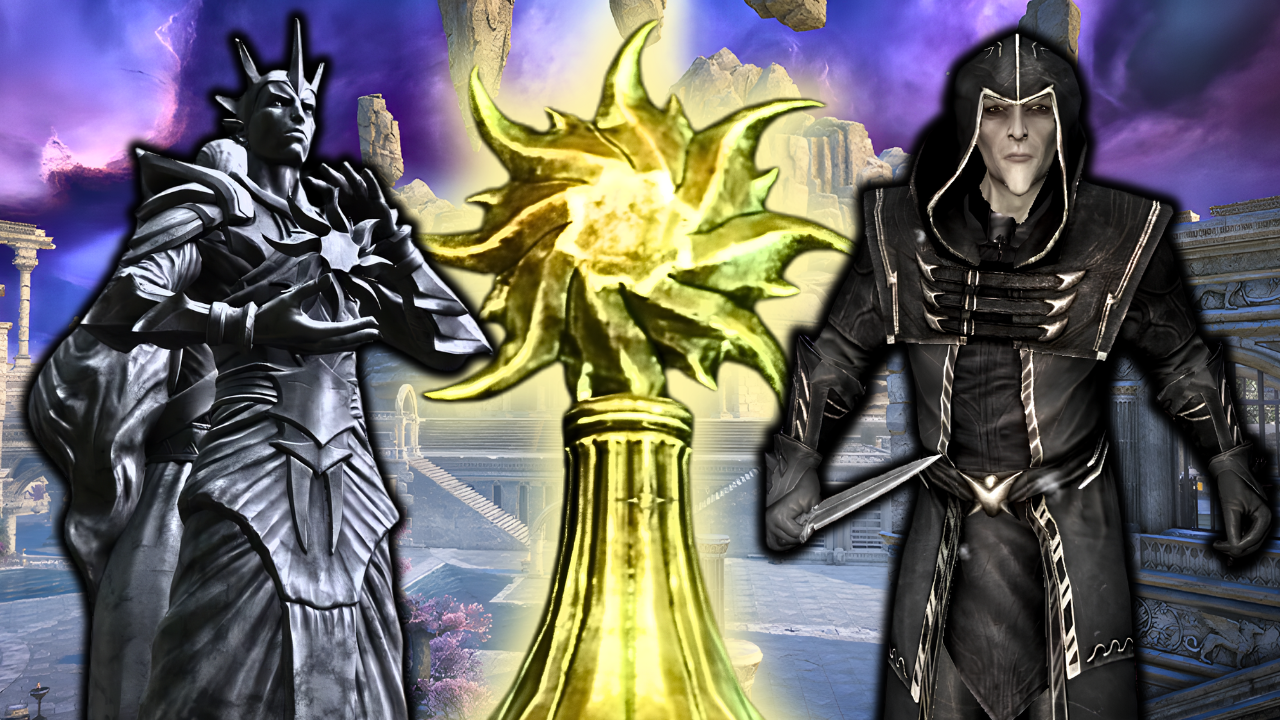
    Image depicting a Thalmor warrior, a shrine to Auri-el, and a statue of Auri-el himself in The Elder Scrolls.

    Conclusion: The Golden Burden

    From the divine halls of Aetherius to the political shadow games of the Fourth Era, the High Elves remain consistent in one thing: their unbreakable pride.

    Their memory is long. They believe in their divine heritage. And even though they are people defined by what they’ve lost, they will stop at nothing to get it back.

    So, were the Altmer right in trying to retain their divine glory? Or were they an imperialist scourge on the continent?

    "Satan Descends Upon Earth" by Gustave Dore

    Final Thoughts

    But before I finish up, I want to cover my thoughts about the history of the High Elves, how I think they overlap with real-world cultures, and how their history fits in through a Christian lens.

    Again, the theology of the High Elves seems to most closely resemble that of the Gnostics — or really any other mystery cult throughout the centuries. Whether it’s Mithraism, Freemasonry, or even Mormonism, there is an overall theme in real-world human culture of believing in a lost divinity.

    For Mormons, it’s the Fall. But what’s interesting about Mormonism compared to normal Christianity is they believe that they are intended to become as gods — a very Luciferian doctrine.

    This even fits into Platonic doctrine. Plato famously believed that the real world is but a shadow of the world of the eternal ideas and that the purpose of life is to awaken this illusion and transcend it.

    This led to the semi-heretical doctrines of the Christian Neoplatonists, who somewhat overlapped with Gnosticism in the belief that the material realm is a trap meant to be transcended.

    Ultimately, what the High Elves are not is particularly Christian. The races of men with their theology generally overlap more with Christian doctrine.

    Men view the mortal realm as a gift instead of a curse, and they seek to honor that gift and live the best lives possible — but without casting the moral realm aside.

    From a political perspective, the High Elves most closely align with any group throughout human history that has focused on racial purity and divine right. So, most notably the Nazis, who seem to have been a major inspiration for the Thalmor of the fourth era.

    But even with all that, I still tend to find the High Elves to be my favorite race in The Elder Scrolls. I love their architecture, their culture, and their history.

    That doesn’t mean I overlook the isolationist nature of their culture, or even their tendency towards slavery. It’s just that aesthetically and culturally, the High Elves are the closest to the divine.

    They may be taking (from a Christian perspective) a heretical approach to recapturing the divine. Not seeking forgiveness of sins, but essentially practicing magic and divine arts to attempt to recapture their divinity.

    But at least there is a focus on divinity, a focus on the light, on the beauty. So that’s why I will always love the High Elves, and I was fascinated to learn more about their culture and their history when creating this guide.