

With seven options to pick from, choosing your class in The Elder Scrolls Online can be a challenge. Learning more about each class, though, will help you make your decision. In this guide, discover the differences between the Dragonknight, Sorcerer, Nightblade, Templar, Warden, Necromancer, and Arcanist — including their class designs and skill lines. Plus, check out gameplay of each class to find out how each option looks and works within the game.
As a new player in The Elder Scrolls Online, there’s a lot to take in. With all the gameplay options and features that have been added over the years, it’s no stretch to say that ESO has become a massive game.
Your ticket into experiencing the game, though, is creating a character. But this is also where many new players meet their first challenge: How do you choose between the seven options that have been presented to you?
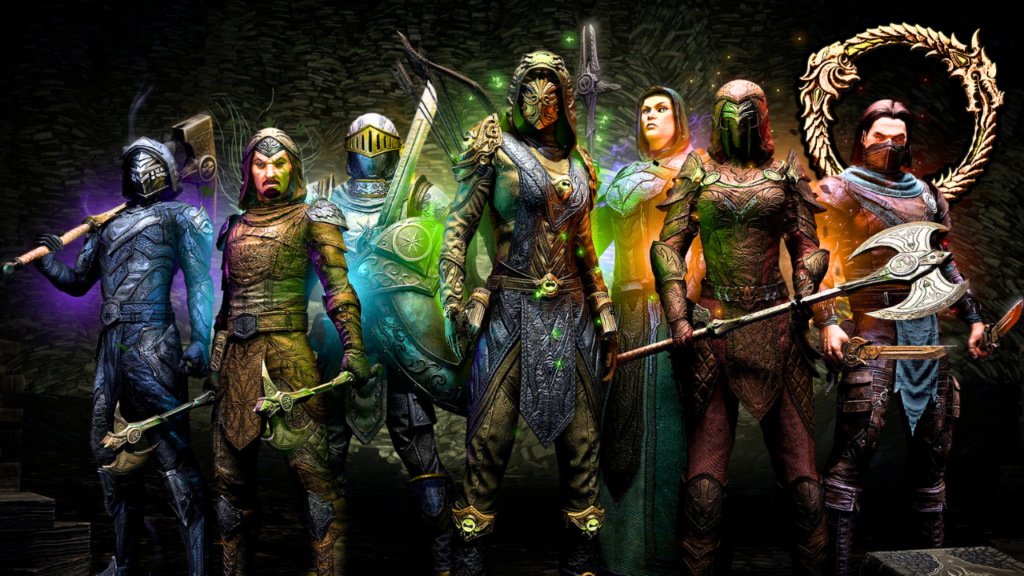
Each class has its own unique identity; its pros and cons. They each evoke a particular aesthetic, and offer distinct playstyles.
In this guide, I’m going to run through each of the seven class options in The Elder Scrolls Online. My goal is to provide a wide overview without getting too bogged down in the details, but also providing you with enough information on each class to make an informed decision.
We’re going to cover the base game classes of the Dragonknight, the Sorcerer, the Nightblade, and the Templar, and also the DLC classes that have been added over the years: the Warden, the Necromancer, and the Arcanist.
Let’s dive into my guide to each of the seven classes in ESO and how to pick the option that’s the best fit for you.
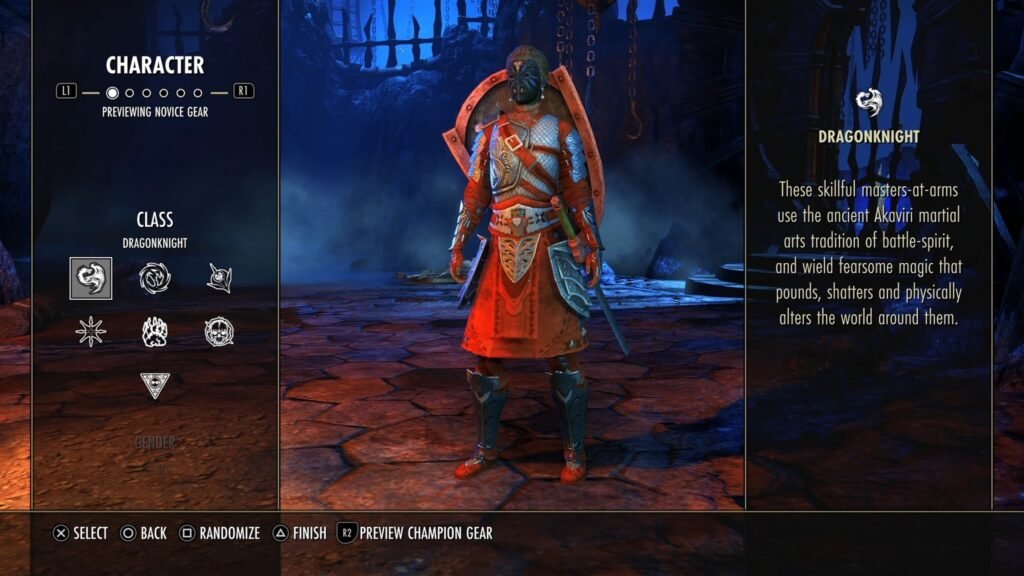
Dragonknight Overview
I’m going to start by providing a general overview of each class, and then I’ll cover each class in turn in a bit more detail. The Dragonknight, as the name suggests, is a dragon-inspired class. The tooltip provided on the character select screen reads:
“These skillful masters-at-arms that use the ancient Akaviri martial arts tradition of battle-spirit and wield fearsome magic that pounds, shatters, and physically alters the world around them.”
Essentially, you’re going to be evoking the power of dragons in this class. You’re going to be breathing fiery breath, using dragon blood to heal yourself, leaping like a dragon, and also using various other flame related skills.
This is great for people who want that traditional fantasy aesthetic, and the Dragonknight was just fully refreshed in a recent update, making it one of the most modern and fun classes in the game.
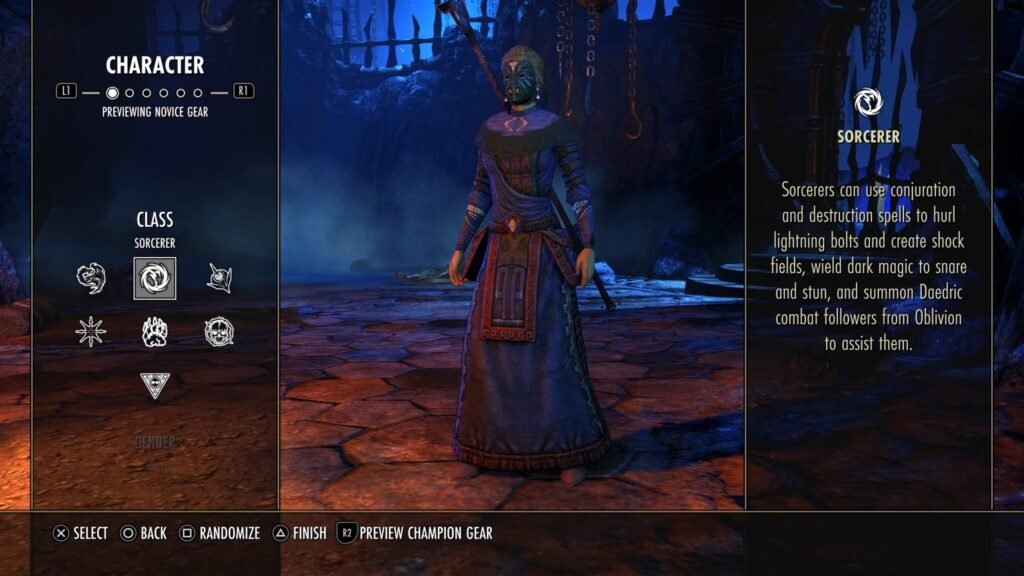
Sorcerer Overview
The Sorcerer, which is my personal favorite, is a more strategic class that’s a great choice for beginners. You have permanent combat pets that follow you around and only go away if they die. You wield dark magic and lightning, and you’re usually a long range character, but there are definitely melee builds that work.
This is a good point to mention that you can use any weapon with any class and you can make any class into either a melee, a ranged magic user, a ranged bow user, a sword and board, etc. But there are certain classes that are better for particular weapons than others due to their unique characteristics.
I love the Sorcerer. I love wielding lightning. What it says about it here in the game is that:
Sorcerers can use conjuration and destruction spells to hurl lightning bolts and create shock fields, wield dark magic to snare and stun, and summon Daedric combat followers from Oblivion to assist them.
So if you like the Sorceress in Diablo II, if you generally like the idea of magic users in fantasy games, I’d recommend the Sorcerer.
I’d also recommend the Sorcerer to any new players because it’s very easy to understand. It doesn’t have much of a learning curve to it and it’s a whole lot of fun.
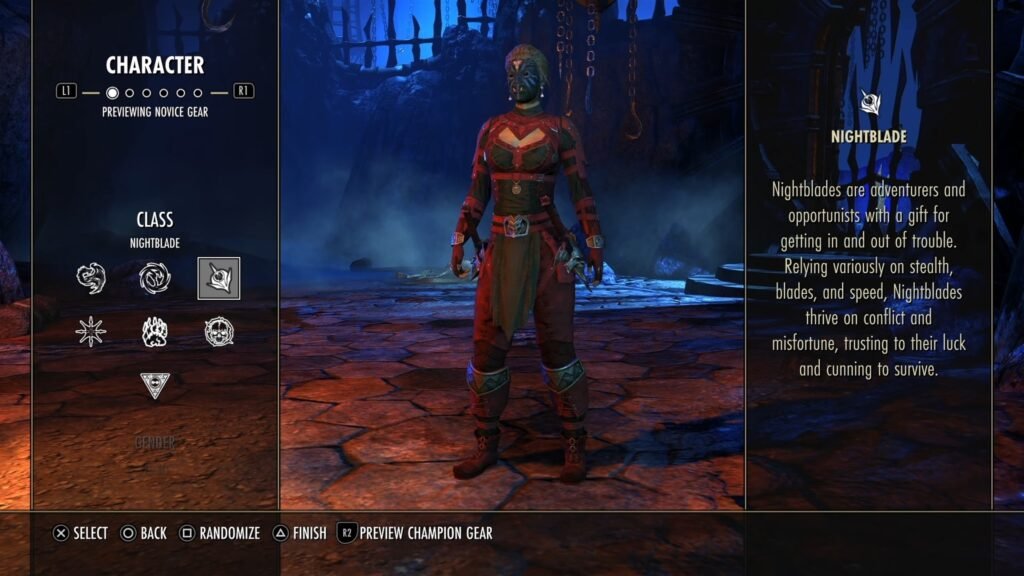
Nightblade Overview
To be completely honest, the Nightblade is my least-favorite class. It’s the one I know the least about. It’s mainly focused on single-target damage, stealth, deception, hiding in the shadows.
It’s mostly designed to be a melee class, but you can use it with a bow or a staff or anything else. It’s kind of the bloody dark assassin sort of class.
In the game tooltip, it says:
Nightblades are adventurers and opportunists with a gift for getting in and out of trouble. Relying variously on stealth, blades, and speed, Nightblades thrive on conflict and misfortune, trusting to their luck and cunning to survive.
The Nightblade can definitely be fun. It’s really good for PvP, but it’s not something I’ve really gotten into myself.
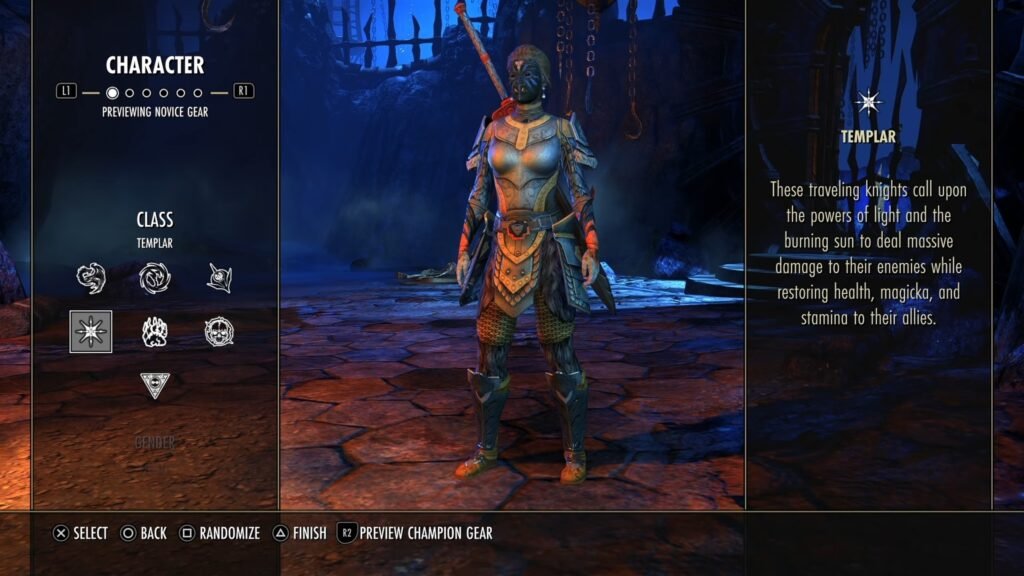
Templar Overview
The Templar, on the other hand, is probably my second favorite class. It is the traditional warrior of light paladin sort of class.
You use a bunch of sun and light-based skills. It’s equally good as a melee character and as a long-range character. It’s great as a DPS or a healer, and you can even make the Templar into a tank.
Generally, I really like the class design behind the Templar. I love the Warrior of Light aesthetic. It’s also a very customizable class where you can make it into a short-range DPS powerhouse or into a healer that keeps your whole trial team going.
The tooltip for the Templar says:
These traveling knights call upon the powers of light and the burning sun to deal massive damage to their enemies while restoring health, magicka, and stamina to their allies.
That’s it for the four classes that were included with the base game. Just to be clear, all of these are free. They come with the base game. There is no separate DLC purchase necessary.
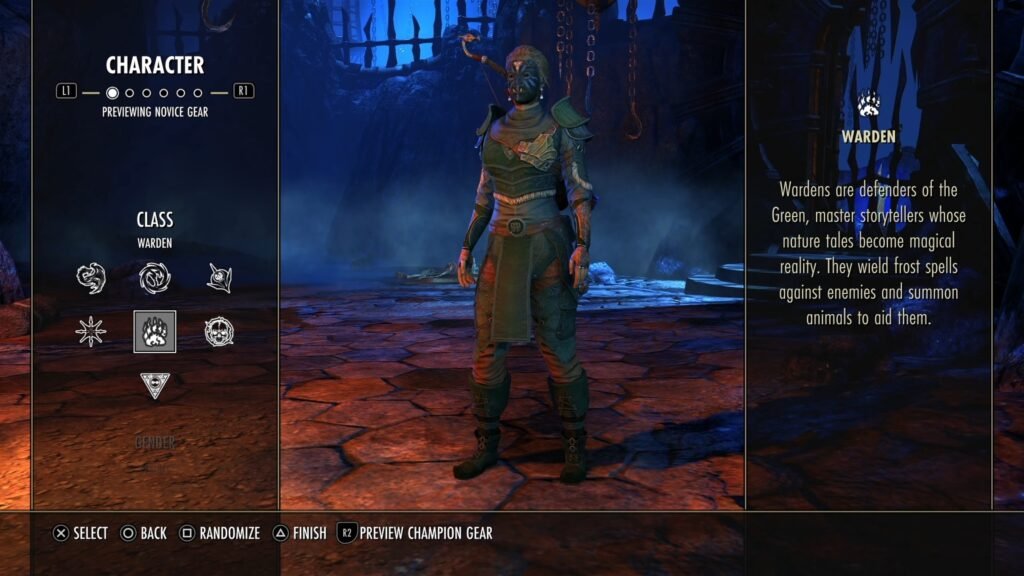
Warden Overview
The Warden was the first DLC class added to the game. Morrowind, the DLC it comes with, is now free, making this class free as well.
This class uses nature magic and animal companions. It’s basically a “bond with nature” kind of class. Sort of like the Druid in other games, but it also wields ice magic, which is very interesting.
The Warden is getting a refresh later in 2026. This guide will be updated when the refresh occurs.
The Warden is a really great healer. It has some really unique skills, including these vines that allow you to launch over to your allies.
It’s also the only other class in the game that has permanent pets. You can summon a giant grizzly bear that does your bidding and attacks enemies.
I do like the warden, but I’ve never really gotten that into it personally. The warden tooltip says that:
Wardens are defenders of the Green, master storytellers whose nature tales become magical reality. They wield frost spells against enemies and summon animals to aid them.
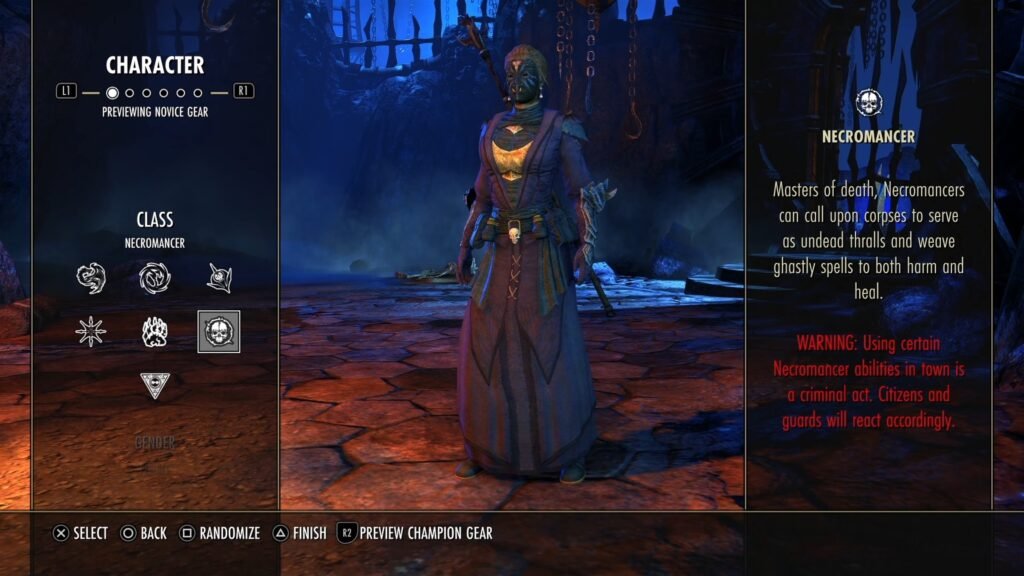
Necromancer Overview
The Necromancer is another DLC class, and you do have to buy it from the Crown Store if you want it for 1,500 Crowns. And I’ll be honest, the Necromancer is weird.
If you’re used to Necromancers from other games, like the Diablo series, this is going to be a bit of a shock. Weirdly enough, you do not have any permanent combat pets. You do have summons, but they disappear after a little while.
There is also usage of corpses, but it’s in ways you might not expect. There’s actually quite a lot of cold damage used by the Necromancer as well, and it is probably the least favorite class in the game among the community in general.
Though, it does work as a really great tank. But again, if you’re looking for the usual kind of Necromancer thing here, you’re not going to get it with this class.
The best I can think is they didn’t want it to overlap with the Sorcerer too much, so they didn’t give it permanent pets. But, I personally cannot wait for the Necromancer rework coming in 2027 (most likely.)
Hopefully, we will get permanent pets with this class at that point. But in the meantime, it does have a really badass scythe skill.
The Necromancer’s tool tip says:
Masters of death, Necromancers call upon corpses to serve as undead thralls and weave ghastly spells to both harm and heal.
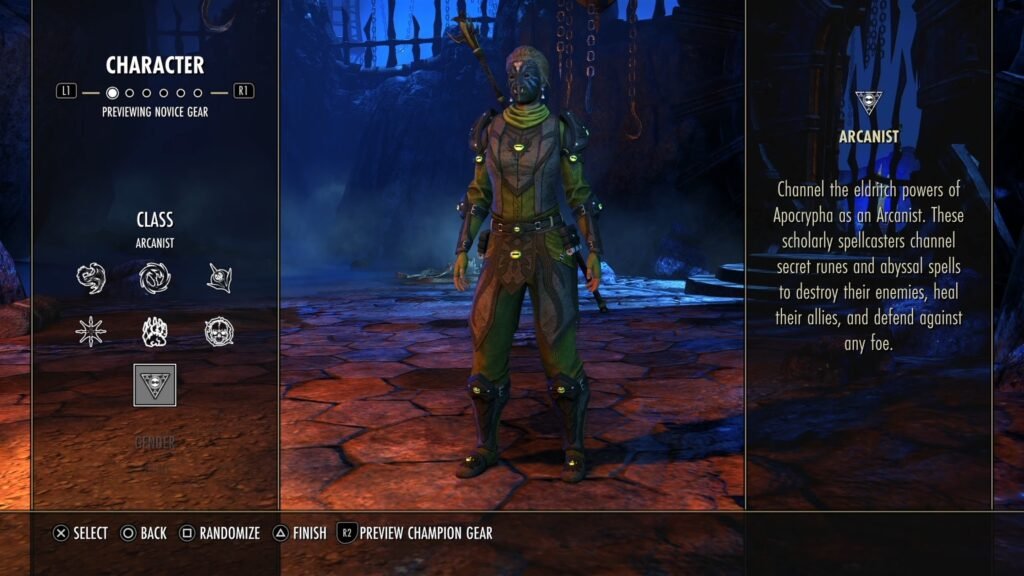
Arcanist Overview
And now for the last class. It is also a DLC class.
The Arcanist is a separate purchase from the Crown Store, again for 1500 crowns.
I do really like the Arcanist. It has a very easy learning curve. It’s probably the easiest class next to the Sorcerer if you’re a new player.
Basically, the idea is you are wielding forbidden knowledge. It’s separate from the Sorcerer because you’re not really wielding dark magic, but it does have kind of a sorcery theme to it.
In most cases, your Arcanist is going to be mid or long-range. It has a really epic beam skill, and you build up something called Crux during combat that enhances the power of your skills. What the tool tip says about the Arcanist is:
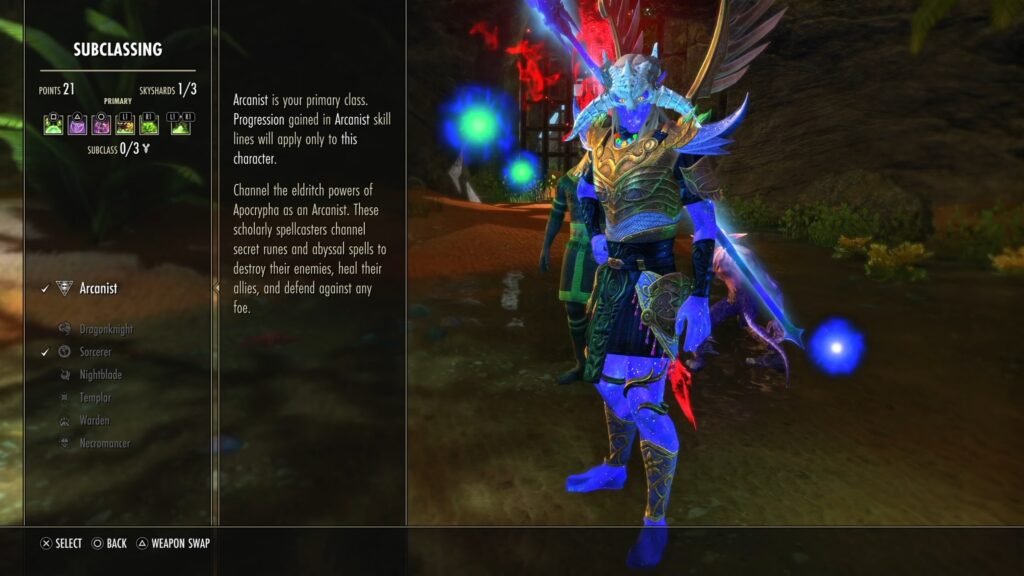
Channel the eldritch powers of Apocrypha as an Arcanist. These scholarly spellcasters channel secret runes and abyssal spells to destroy their enemies, heal their allies, and defend against any foe.
Class Overview Summary
That’s the basic overview of the classes. And by the way, if you are ready to go ahead and make a character, I do have a video on how to create a character in ESO. But, now that we’ve covered the basics of each class, let’s dive into each one in turn to provide a little bit more detail.
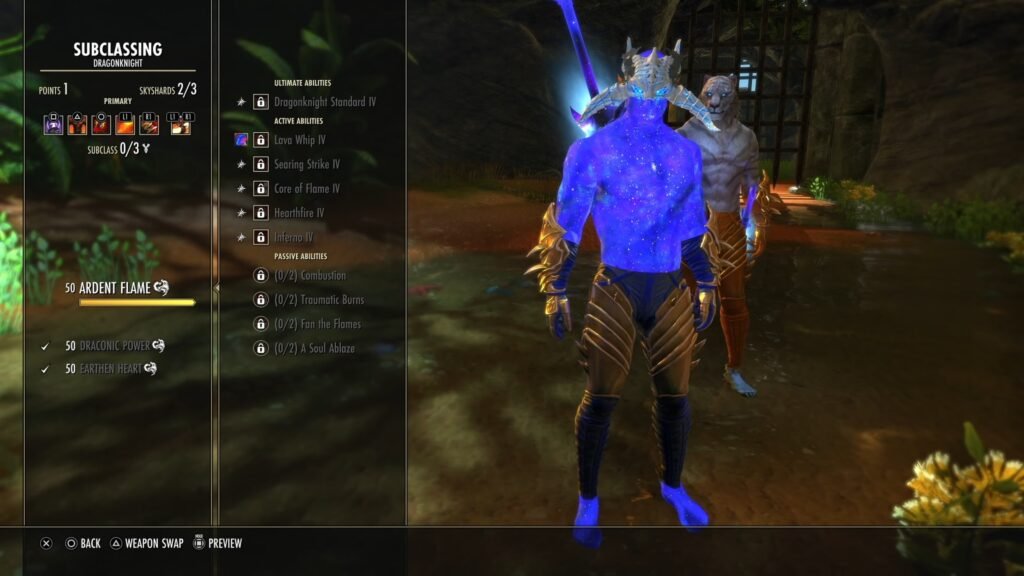
ESO Dragonknight Guide
We’re going to start with the Dragonknight. Again, the Dragonknight is the first class to receive the refresh campaign that ZOS (ESO’s developer) is engaging in to refresh every class to fit the modern era, hone in on their distinct identity, make them more competitive with newer classes like the Arcanist.
As a result, the Dragonknight is arguably the strongest class in the game right now, and in my opinion, it’s currently the most fun to play.
The Dragonknight has three class skill lines: Draconic Power, Earthen Heart, and Ardent Flame. Each of these skill lines is somewhat tailored toward a specific role, but the developers have also tried to make them synergize with each other so that instead of subclassing, you might want to keep the whole class skill line set together.
Probably the most iconic skill under Ardent Flame is Lava Whip, which as the name suggests, allows you to fling a whip of lava at your enemies. But the best skill line in my opinion is Draconic Power, which includes skills like Dragon Leap, the ultimate skill that allows you to jump up in the air, launch yourself on enemies, knock them up into the air, and do a mass amount of damage.
Engulfing Dragonfire is also an amazing skill. It’s probably the best skill for taking down large groups of trash mobs at this point. And Blood of the Elder Dragon is also a great healing skill.
In Earthen Heart, you have the skill Magma Armor, which as the name suggests, covers your body with magma and does damage to enemies around you. There’s also Shatterspike Mantle, which shoots out spikes from you, sort of like the spines on a dragon’s armor, and also Molten Weapons, which changes the appearance of your weapons and empowers them to do more damage.
All in all, the Dragonknight is a super powerful class right now. It’s also a great deal of fun. Skills like Engulfing Dragonfire have been completely reworked, making them both more powerful and more enjoyable to use.
If your goal in playing ESO is simply channeling sheer power, calling upon the power of flame, calling upon the power of dragons, the Dragonknight is the class to choose. More than any other class in the game, I feel like it evokes that pure raw power idea where you’re just a powerhouse jumping in, dealing damage, taking control of the battlefield.
It is mainly melee, mainly DPS. Like any other class in the game, you can tweak it and shift it around to make it work for you in any way that you like.
ESO Sorcerer Guide
Moving on to the Sorcerer, which is still my favorite class in the game, even with the Dragonknight rework.
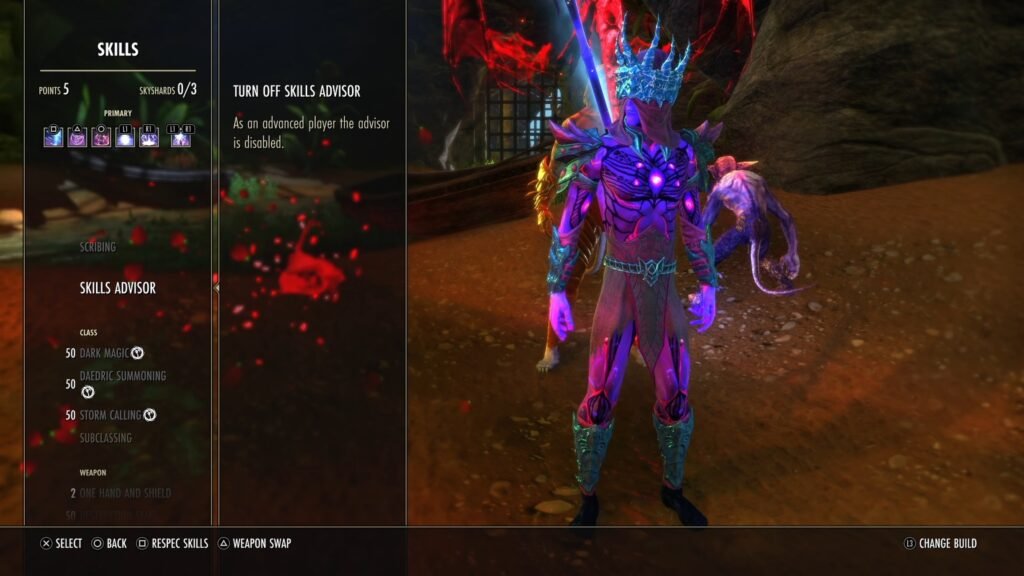
I love the fact that you can have two permanent combat pets at a time under the Daedric Summoning skill line. The Volatile Familiar, which is the evolution or “morph” of the Unstable Familiar, and the Twilight Matriarch, which is the morph of the Winged Twilight.
The Volatile Familiar is a great damage-over-time (DoT) area-of-effect (AoE) skill, and the Twilight Matriarch is arguably the best healing skill in the game. Under Daedric Summoning, you also have skills like Hardened Ward, which provides a very powerful damage shield.
The other class skill lines include Dark Magic, which is most notable for Crystal Fragments. This skill lobs a huge glowing crystal at your enemies. Using other skills allows it to proc instantly. Usually, it has a little bit of a cast time to it, but using another ability has a 33% chance of making Crystal Fragments cast instantly, making a really powerful single-target skill.
The last class skill line is Storm Calling, which includes both Lightning Form and also Power Overload, the ultimate skill. This is why I affectionately call the “Palpatine Hands” skill. You just shoot lightning out of your fingertips, and it makes short work of trash mobs while also serving as a very powerful PvP ultimate.
What I probably like the most about the Sorcerer is that it’s so easy to use. It pairs especially well with the Oakensoul ring, which gives a lot of buffs, but restricts you to only using one bar of skills.
If you want to keep things simple, choose a Sorcerer. Also, choose a Sorcerer if you want to channel that traditional magic-casting vibe.
Sorcerers are generally long range magic casting characters, but again, like any other class in the game, you can make this into basically anything you want.
The Sorcerer is fun, easy to use, very easy for new players to understand, and it’s one of only two classes in the game that has permanent combat pets.
ESO Nightblade Guide
Moving on to the Nightblade — and again, I am not the preeminent Nightblade expert. It is the class that over my 12 years of playing ESO I have played the least by a wide margin, but I do know enough about it to give an overview and hopefully help you choose if this class is right for you.
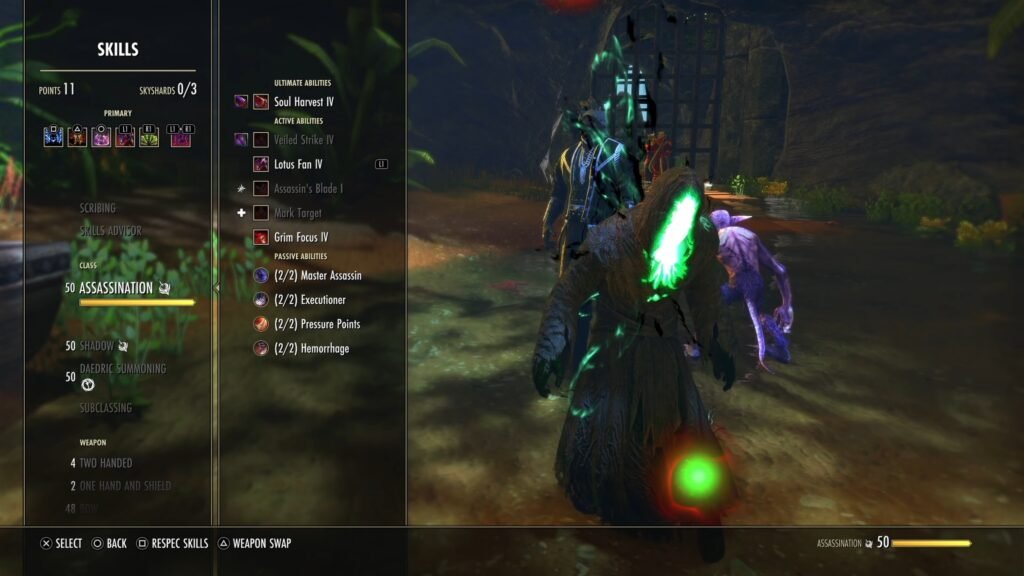
The Nightblade uses three class skill lines just like every class: Assassination, Shadow, and Siphoning. Siphoning is mainly centered around using the power and life force of your enemies against them. You have ultimate abilities like Soul Shred, normal abilities like Siphoning Strikes.
Shadow is all about hiding in the shadows, summoning shadowy familiars using Dark Shade, and even healing and increasing the movement speed of you and your allies with skills like Refreshing Path.
Assassination, as the name suggests, is all about hiding and leaping out of the shadows with ultimate abilities like Soul Harvest and normal abilities like Lotus Fan, which allows you to launch yourself across the map, taking enemies by surprise.
If you’re a fan of the Assassin’s Creed franchise, you might want to start with this class, but it does have quite a learning curve to it. It’s really good for single-target attacks, for taking down bosses.
It’s also the default PvP class due to its ability to just hide and then strike from the shadows. But if you’re making your first character in the game, the Nightblade might be a little too complicated.
It’s also not as great as a Sorcerer or the Arcanist or even the Templar for it clearing through early game content like Zone Story quests, the Main Story quest, etc.
The Nightblade is something I almost wish I knew more about, but it’s really not my thing. I just know enough to say that it is a good assassin class. It’s great for stealth and subterfuge.
ESO Templar Guide
Moving on to the Templar, which is probably my second or third favorite class overall. Essentially, you are a warrior of light.
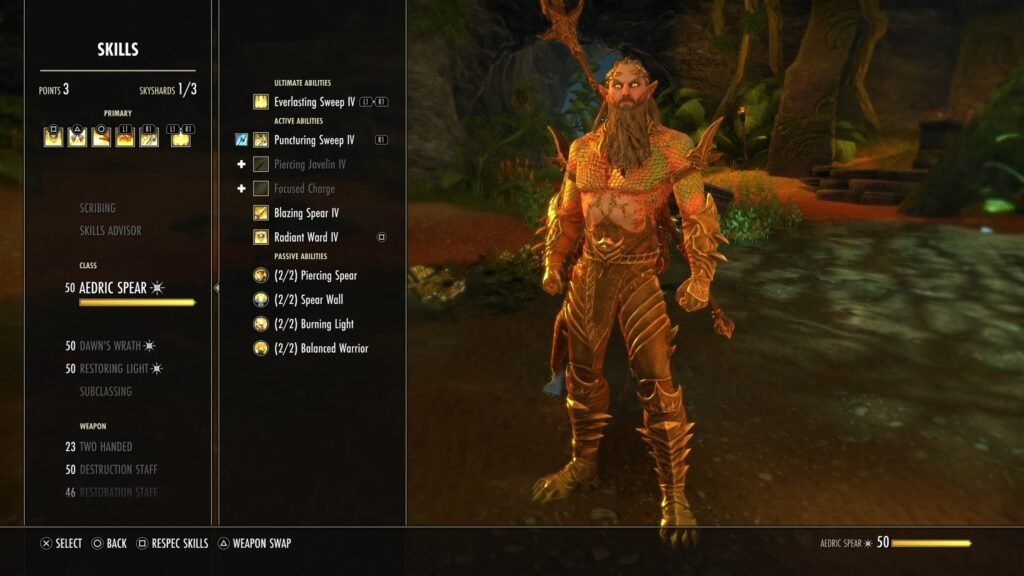
The Aedric Spear skill line is centered around channeling the spears of the heavens to impale your enemies. You have the ultimate Everlasting Sweep, which uses very little ultimate. You can cast it all the time. It provides an area of effect damage aura.
You also have the classic Puncturing Sweep, also known as the “jabs skill,” and Radiant Ward, which is a great shield.
Under the Dawn’s Wrath skill line, the main highlight is Radiant Glory, aka the Jesus Beam. This is an incredibly good execute single-target skill, great for taking down bosses in their last third of life. It’s also just a beautiful skill overall. It has some great aesthetics to it.
And then you also have Restoring Light, which is a healing-focused skill line. This is the only base game class that has a skill line entirely devoted to healing. And in it, you have skills like Hasty Prayer that heals you and your allies, and Cleansing Ritual, which can morph into Ritual of Retribution, which provides damage in an area and also makes a very beautiful glowing circle.
So, the Templar is also pretty easy to learn for new players. It’s pretty straightforward and has dual purpose as either a melee DPS or a healer. You can also make Templars into tanks, but the class isn’t really designed for that.
But overall, what I really like about the Templar is it’s aesthetic; the whole vibe behind the character, the theme behind it, using holy light to destroy your enemies and heal your allies.
If you’re really not sure what to do and you want something that’s a little bit more light and less occultish than the Sorcerer, I would really suggest the Templar.
ESO Warden Guide
Moving on to the DLC classes, starting with the Warden. I’ll be honest with you, the Warden is kind of weird.
It’s definitely not a Druid, but it’s not anything else really either. It’s a really great healer, but as far as other roles go, it’s kind of confusing as a DPS character.
It definitely has a steep learning curve with many abilities not doing as much damage as you’d like. But if you do like the nature-magic, Druid kind of vibe, pick the Warden.
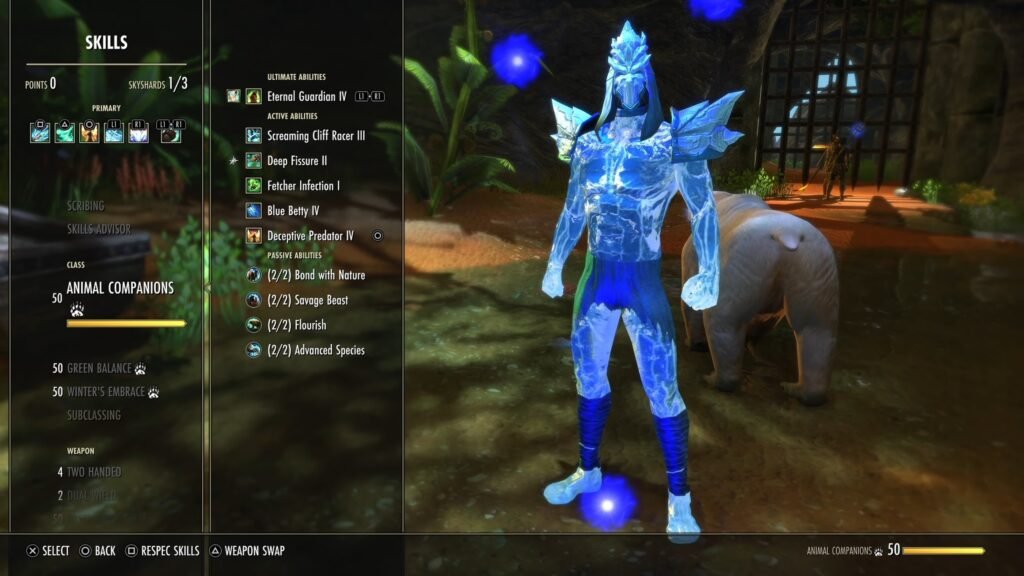
It has three class skill lines. Animal Companions is the first, and that’s where you get your bear from. It is an ultimate skill, and you can cast it after having enough ultimate to attack a single enemy.
You also have the skill Screaming Cliff Racer, which is a pretty good single-target skill, and Deceptive Predator, which makes these big ol’ wings and increases your movement speed.
Green Balance is a dedicated healing skill line, and it includes skills like Enchanted Growth, which heals allies in front of you, Leeching Vines, which casts vines onto you or an ally to heal them over time, and also Bursting Vines, which is just fun.
It’s weird. It allows you to launch yourself like Tarzan or something at an ally, and it heals the ally. It’s great for traversal, but yeah, it’s just bizarre.
You also have a cold-based skill line that includes shield skills like Expansive Frost Cloak and Shimmering Shield, Gripping Shards, which is an area of effect DPS skill, Polar Wind, a healing skill, and Frozen Gate which creates a portal.
I’ll be level with you. Warden has a pretty steep learning curve. It definitely has niche appeal for lots of people, but it’s pretty difficult for new players to understand.
I think it’s difficult even for experienced players understand — and even for the developers to understand — which is probably why Warden is the next class slated for a rework.
Hopefully, the developers will make the class just make more sense. I really want to like Warden.
So, long story short, if you really like Druid or nature magic classes, try the Warden. But don’t be surprised if you’re disappointed or confused.
ESO Necromancer Guide
Speaking of disappointed and confused, meet ESO’s Necromancer.
Maybe I was just spoiled from playing Diablo II too much as a kid, but when I think of a Necromancer, I think of hordes of undead minions responding to my beck and call, swarming enemies — and you won’t get anything like that with ESO’s Necromancer.
There are no permanent summons. They all go away after a while. It has a weird relationship with cold, and corpses are sort of a take it or leave it kind of thing instead of the core of the Necromancer’s identity in this game.
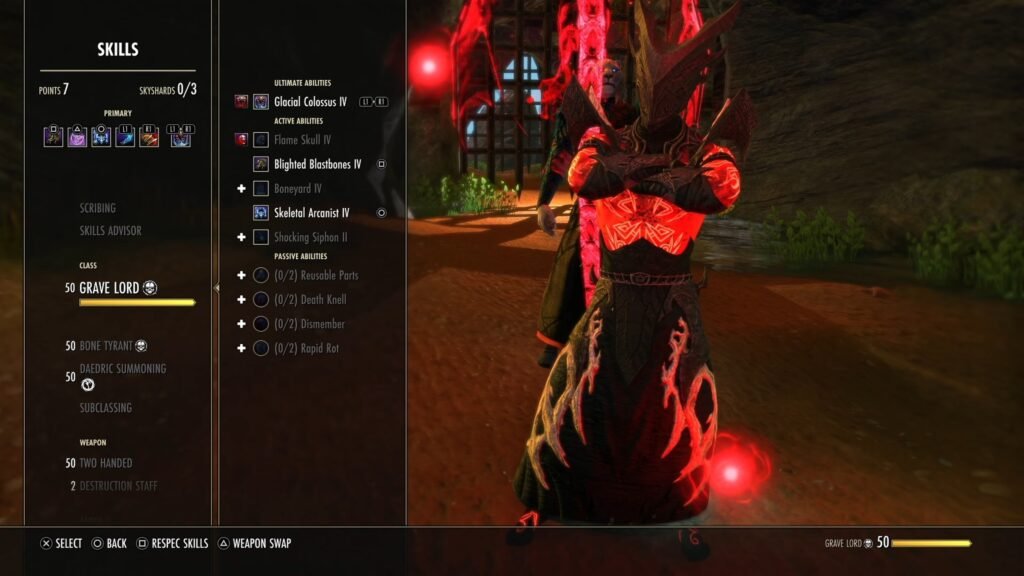
Your three class skill lines are Grave Lord, which is sort of a summoning skill line, but again, they’re all temporary. You have the ultimate Glacial Colossus that summons a giant Flesh Atronach to pummel the ground. Blastbones, which is a great PvP skill. And, Skeletal Arcanist, which only lasts 20 seconds but is sort of like a skeletal mage from the Diablo series.
Then you have Bone Tyrant, the main highlight of which is Hungry Scythe, which summons a giant scythe to sweep the enemies in front of you. It’s a great area-of-effect DPS skill. And when I say great, I mean it looks great and it feels great to use, even though it’s not really that powerful.
The Necromancer’s third skill line is Living Death, which is a healing-oriented skill line that allows you to summon a temporary Spirit Mender pet, tethers you to corpses to heal yourself and allies, and also provides other healing utility.
While I love the Necromancer in the same way that I will love any class called a Necromancer in any game, I know I’m not the only one left confused by the design aesthetic that went into the Necromancer in ESO.
I guess ZOS wanted to do something unique, and they definitely succeeded in that. But they stirred the pot so much that the resulting concoction can’t even really be called a Necromancer in the traditional sense.
Necromancers are pretty good healers. They’re even better tanks, but what they aren’t good at is making any sense, both for veteran players and new players alike.
You may want to pick this class if you want to channel the whole Lord of Death idea here, but it has a pretty steep learning curve that never really drops off because you get to the end of it… and you are still confused.
ESO Arcanist Guide
Lastly, we have the final DLC class, the Arcanist.
Now, I love the Arcanist. It is fun. It is easy to use. When it came out in 2023, it really displayed all of the learning that ZOS had done with his other classes.
It has distinctive healing, tanking, and DPS skill lines. It has a crazy-powerful beam skill, and the whole idea of Crux, which you generate during combat and then spend to empower your other skills, is just genius.
I feel like the Arcanist is a pretty much a flawless class. The whole thing makes sense from top to bottom. It’s cohesive, it’s innovative, and it’s a lot of fun to play.
I feel like they chose a real class identity with this one and stuck with it instead of cobbling together a bunch of weird junk like they did with the Warden and the Necromancer.
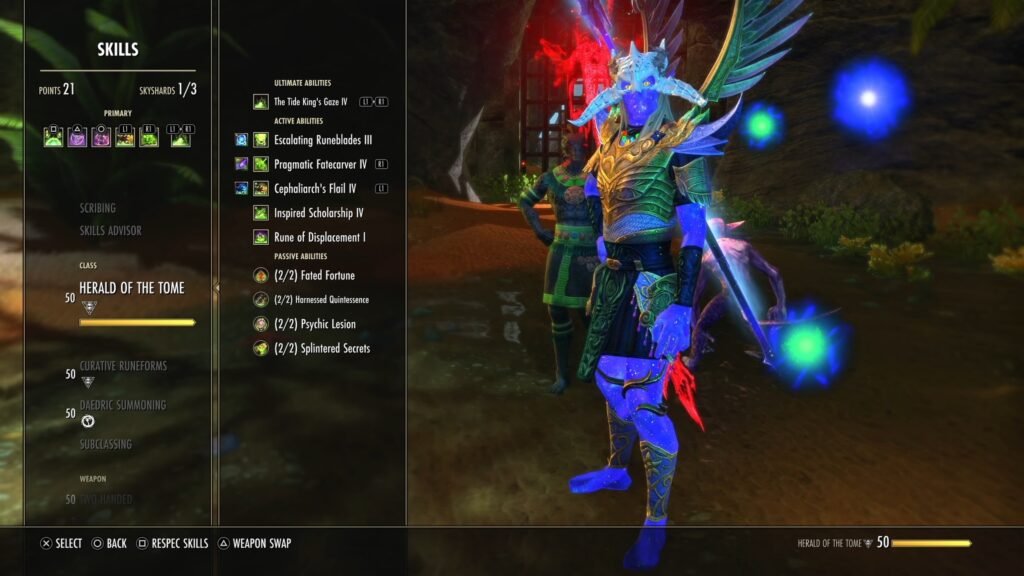
The three class skill lines are Herald of the Tome, which is a DPS skill line that includes the Tide King’s Gaze, the morph of the Unblinking Eye that is a very powerful ultimate. It casts down a beam from above that follows enemies.
You also have Abyssal Impact, a morph of Cephaliarch’s Flail that is great for generating Crux, and Pragmatic Fatecarver, a morph of Fatecarver that is absolutely amazing at using that Crux.
This is probably the best beam skill in the game. It does damage in an area of effect. You can control its direction. It’s basically a giant laser.
Then you also have Curative Runeforms, which is the healing skill line. The main highlight of which for me is Chakram of Destiny, the giant green frisbee skill. You basically throw frisbes at yourself and your allies. They circle around you and they provide you with a damage shield.
This is really fun for just punking people in social areas — just throwing frisbes at them until they go insane.
And then you do also have Soldier of Apocrypha, the tanking-themed skill line, which has damage-mitigating skills like Runespite Ward, Fatewoven Armor, and Runic Defense.
Next to the sorcerer, the Arcanist is probably the easiest class to learn. It’s really easy for new players, but you do have to buy it as a separate purchase for 1,500 Crowns.
It’s also still one of the most competitive classes in the game. It’s right up there in the S-rank tier alongside the new-and-improved Dragonknight. If you want to do a lot of damage and be competitive right from the start, choose the Arcanist.
ESO Subclassing Guide
And before we go, a quick note about Subclassing.
Subclassing is a new feature added in 2025 that allows you to take skill lines from other classes and put them on any class in the game. On any of your characters that have already reached level 50, you can Subclass up to two skill lines from other classes.
You can only take one skill line from each other class. And you do have to get those skill lines up to Level 50 on that class before they can be subclassed.
Subclassing is highly controversial, but I think it is a great addition to the game. It has created a meta in the game where it was supposed to make the game more free, make it easier to experiment.
So, it’s kind of had a counteractive effect compared to its original design. But, it’s really important to keep in mind the existence of Subclassing when you make a character because you aren’t limited to the skill lines on the class that you choose.
You can simply make another character, get their skill lines to Level 50, and then transfer over one of those skill lines to your original character.
Conclusion
All right, that does it everybody. My goal was to provide a general overview while also getting into the different skill lines — mainly focusing though on the idea, on the vibe, on the aesthetic behind each class because that’s what I really feel like you should focus on as you’re making your first character in the game.
Not which class is the most powerful, not which one is the most competitive, but simply which class you feel the most drawn to.
Even as a brand new player, you have eight character slots. Do not be afraid to experiment. Make a character for each class if you want to try them all out, but do listen to that voice inside as you figure out which one you want to make first.
If you want a holy light aesthetic, go for the Templar. If you want to wield dark magic, go for the Sorcerer. If you want what’s most powerful, go for the Arcanist or the Dragonknight.
The point is, the choice is in your hands. Dive into The Elder Scrolls Online with whichever class appeals to you the most.
Leave a Reply